GIFTED EARTH KEEPERS FARM

Advancing Controlled Environment Agriculture

A non-profit research farm developing AI-optimized systems for year-round organic hydroponic saffron cultivation through open science and precision control systems.

100% Organic Methods
11 Sensor Channels
±0.1 pH Accuracy
525K Data Points/Year
100% Open Source
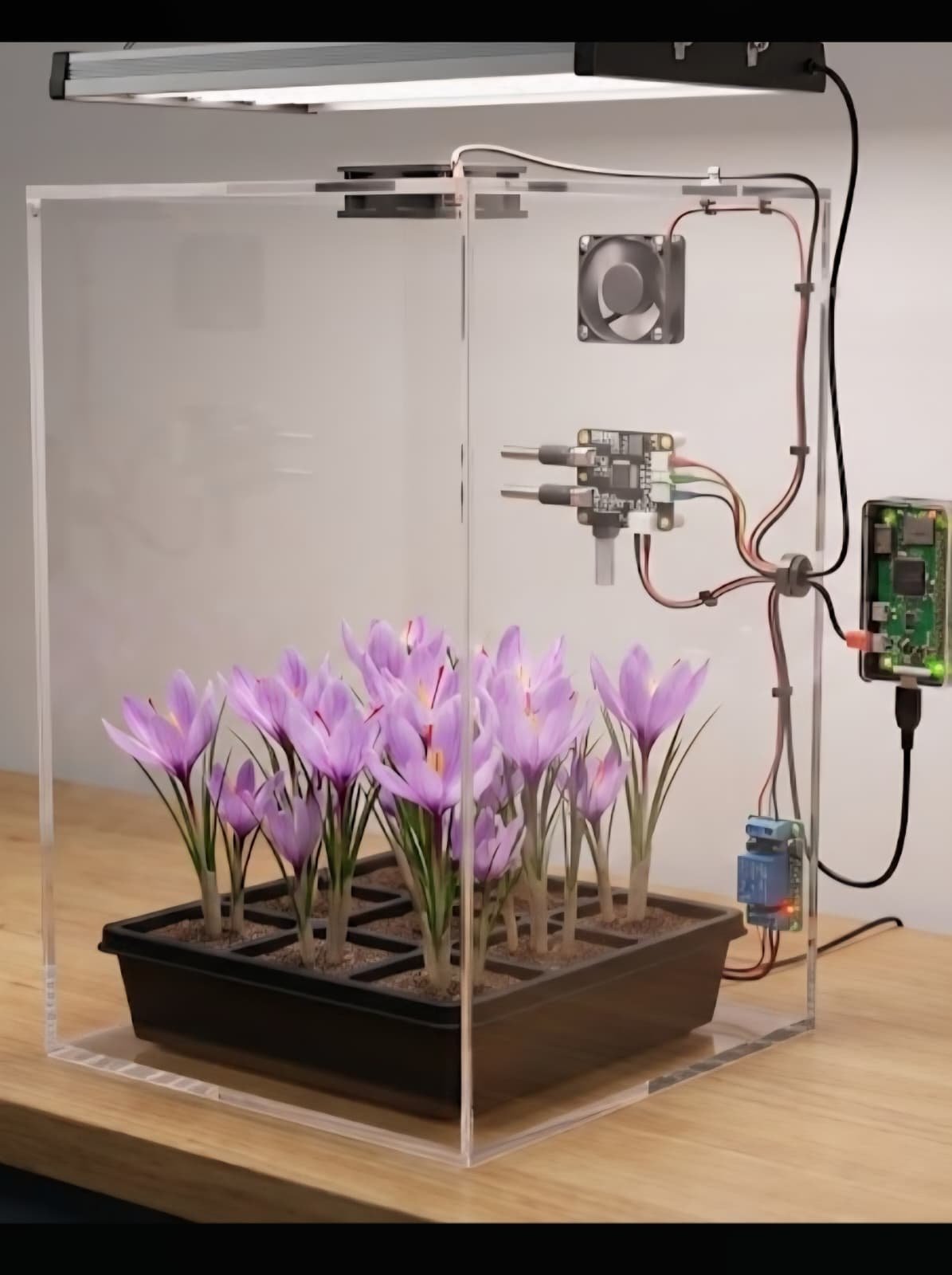
GEKF Saffron Hydroponic Research Chamber

Hydroponic Saffron Research Chamber v3.0

A precision-controlled environmental chamber enabling year-round organic cultivation of Crocus sativus L. through Deep Water Culture (DWC) hydroponics with automated nutrient delivery.

Research Objectives

Saffron (Crocus sativus) is the world's most expensive spice ($5,000-10,000/kg), yet traditional cultivation is limited by seasonal and geographic constraints. Our research aims to:

Primary Goals

  • Achieve 50-70% flowering rates (vs 6% traditional)
  • Reduce cultivation cycle from 52 to 18-26 weeks
  • Maintain ISO 3632 Category I stigma quality
  • 100% organic nutrient system
  • GUM-compliant measurement uncertainty

Why Hydroponics?

Soil-free cultivation eliminates pathogens, enables precise nutrient control, and allows year-round production independent of geography.

Key Advantages

  • Precise pH control (6.0-7.0 optimal range)
  • Real-time EC monitoring for nutrient strength
  • Root zone oxygenation via air stones
  • Automated nutrient dosing (PID control)
  • 90% water reduction vs soil cultivation

Market Context: Global saffron market projected to reach $1.83B by 2030 (7.5% CAGR), with pharmaceutical-grade commanding $50-100/g premiums.

Organic Hydroponic Parameters

Deep Water Culture (DWC) system with automated pH and EC regulation using OMRI-listed organic nutrients (General Organics BioThrive series).

pH Target

6.5 pH
Tolerance: ±0.3 pH
Accuracy: ±0.1 pH

EC Target (Flowering)

1800 uS/cm
Tolerance: ±200 uS/cm
Temp-compensated to 25C

Water Temperature

18 C
Target: 18-20C
Max: 22C (root health)

Reservoir Volume

20 L
Auto-refill at 20%
Change: 7-10 days

Dissolved Oxygen

>6 mg/L
Dual air stones
4 LPM aeration

Dosing Pumps

4 channels
Nutrient A, B, pH+, pH-
PID-controlled

Organic Nutrient Formulas by Growth Stage

Growth Stage BioThrive Grow BioThrive Bloom CaMg+ EC Target pH Target
Dormant (Summer) 1.0 ml/L 0.5 ml/L - 800 uS/cm 6.5
Flowering (Fall) 1.0 ml/L 3.0 ml/L 1.0 ml/L 1800 uS/cm 6.3
Vegetative (Winter) 2.0 ml/L 1.0 ml/L 1.0 ml/L 1600 uS/cm 6.5
Corm Bulking 1.5 ml/L 3.0 ml/L 1.5 ml/L 2000 uS/cm 6.5

Three-Phase Cultivation Protocol

Our system manipulates environmental and hydroponic parameters to guide saffron corms through their complete lifecycle independent of natural seasonal cues.

01

Summer Dormancy

Reset developmental state through controlled stress

  • Air: 26C day / 24C night
  • Humidity: 0-45%
  • Light: Complete darkness
  • EC: 800 uS/cm (minimal)
  • Duration: 4-6 weeks
02

Fall Flowering

Trigger reproductive phase through cooling

  • Air: 18C day / 10C night
  • Humidity: 70-80%
  • Light: 10h photoperiod
  • EC: 1800 uS/cm
  • Duration: 6-8 weeks
03

Winter Vegetative

Maximize corm multiplication and mass

  • Air: 18C day / 12C night
  • Humidity: 50-60%
  • Light: 14h photoperiod
  • EC: 1600-2000 uS/cm
  • Duration: 8-12 weeks

Research-Grade Sensor Array

11-channel monitoring system with GUM-compliant measurement uncertainty quantification. All readings include Type A (repeatability) and Type B (systematic) uncertainty components.

Environmental Sensors (Air Chamber)

BME280
Air temperature, humidity, pressure
Accuracy: +/-0.5C, +/-3% RH
MH-Z19C NDIR
CO2 concentration (400-5000ppm)
Accuracy: +/-50ppm + 5%
BH1750
Light intensity (lux) + PAR estimate
Accuracy: +/-20%

Hydroponic Sensors (Nutrient Solution)

DFRobot pH Probe
Solution pH (0-14 range)
Accuracy: +/-0.1 pH
DFRobot EC Probe
Electrical conductivity (0-20 mS/cm)
Accuracy: +/-2%, temp-compensated
DS18B20 Waterproof
Water temperature (submersible)
Accuracy: +/-0.5C
HC-SR04 Ultrasonic
Reservoir water level
Accuracy: +/-3mm

Actuators & Control

Peltier TEC1-12706
Thermoelectric cooling (2x 60W)
PTC Ceramic Heater
100W heating element
LED Grow Panel
Full-spectrum 20W (5:1 R:B)
Peristaltic Pumps (x4)
Nutrient A/B, pH Up/Down

Computing & Software

Raspberry Pi Zero 2 W
Embedded Linux control system
PID Controllers
Temperature, pH, EC regulation
Flask + SocketIO
Real-time web dashboard
SQLite + JSON
Time-series data logging

FAIR Data Principles

All research data follows FAIR principles (Findable, Accessible, Interoperable, Reusable) with complete provenance tracking and measurement uncertainty.

Environmental Logging

  • Sampling Rate 10 sec
  • Channels 6
  • Data Points/Day 51,840
  • Uncertainty Tracking GUM k=2

Hydroponic Logging

  • Sampling Rate 60 sec
  • Channels 4
  • Data Points/Day 5,760
  • pH Calibration 14 days

Dosing Audit Trail

  • Event Logging Immediate
  • Max Daily Doses 20
  • Lockout Period 10 min
  • Export Format JSON/CSV

Experiment Tracking

  • Protocol Versioning Git-style
  • Hardware Config SHA-256 hash
  • Audit Trail Immutable
  • GLP Compliance Yes

100% Open Source

All software, hardware designs, and protocols are freely available under permissive licenses. Reproducibility is a core principle.

Software Modules

# Hydroponic Saffron Research Box v3.0 from sensors import HydroponicSensorArray from nutrient_control import NutrientController from experiment import ExperimentManager from calibration import SensorCalibrator from web_dashboard import run_dashboard # Initialize hydroponic system sensors = HydroponicSensorArray() nutrients = NutrientController() experiment = ExperimentManager("experiments") # Start real-time monitoring run_dashboard(host="0.0.0.0", port=5000)

Module Overview

  • sensors.py - 8 physical + 3 derived channels
  • nutrient_control.py - PID-based dosing
  • experiment.py - FAIR data management
  • calibration.py - GUM uncertainty
  • web_dashboard.py - Real-time UI

Replication Guide

Everything needed to replicate our research setup:

Documentation Included

  • Complete Bill of Materials (~$700)
  • Wiring diagrams & GPIO pinouts
  • Organic nutrient mixing schedules
  • Sensor calibration procedures
  • Experimental protocols (ISO 3632)

Hardware Requirements

  • Raspberry Pi Zero 2 W (or Pi 4)
  • ADS1115 16-bit ADC module
  • 8-channel relay module
  • DWC reservoir (20L)
  • 4x peristaltic dosing pumps

Collaborate With Us

We welcome collaborations with researchers, universities, and agricultural organizations interested in advancing controlled environment agriculture.

info@gekf.us